
Cima 100
ISMACS News Number 154 Cover Image
Secret Singer Sewing Machines
Part 2 - The Spanish Connection
In the first part of this article, published in the March 2024 issue of ISMACS News (#153), it was explained that the well-known Hexagon vibrating shuttle sewing machine, manufactured in Clydebank, Scotland between 1919 and 1924, was not the only model of this brand, as is often believed.
Indeed, that machine, which we now know as the Hexagon No.2, had been preceded by another vibrating shuttle machine, the almost unknown Hexagon No.1, which had been manufactured in Elizabethport, New Jersey, USA, between late 1916 and 1918.
After reading that first part, we also know that, in parallel with the No.2, Clydebank produced two other Hexagon models: the central bobbin Hexagon No.3, between late 1922 and 1924; and the extremely rare Hexagon No.4, another vibrating shuttle machine, briefly manufactured in 1923.
But what if we told you that there were two more Hexagon sewing machines? Yes, six different Hexagon models are known to exist, and we have not ruled out the possibility of other models popping up in the future.
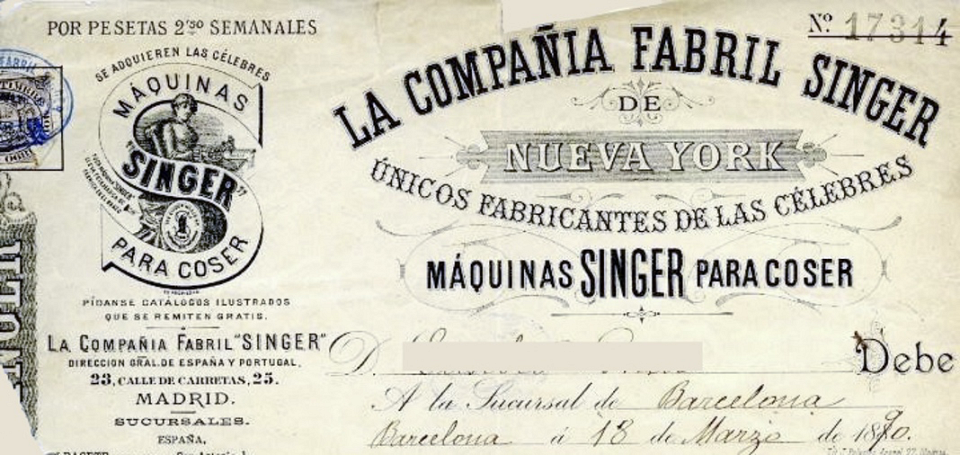
Figure 1:
Header of an 1890 invoice from "La Compañía Fabril Singer”, with permission from Afernet Brocanter
These two additional Hexagon sewing machines will be unveiled in this article. To do this, we have to change the country: the story of Hexagon now moves to Spain. But beyond those specific machines, we also have to explain the business circumstances and the historical context that made that country so important in the history of Hexagon sewing machines.
Singer Spain, Before 1907
Around 1862, Lacour y Lasage, a Barcelona company that marketed various products (from fabrics to chemicals), began importing sewing machines. We have not been able to find out what brand those first machines were, but the ships transporting them departed from Marseille. Maybe those machines were French.
Over the next few years, evidence shows that this company simultaneously sold machines from different sources: Charles Raymond, Wheeler & Wilson, Howe, Jones and... Singer! Obviously, exclusivity and loyalty to a brand were not the company's motto nor that of its dealers, a situation that must have displeased Singer quite a bit.
Around 1885, all traces of Lacour y Lesage vanish, but that company had long since lost its status as Singer’s agent. Indeed, around 1871, Singer’s London office sent to Spain, as a traveling canvasser, a 26-year-old Englishman who had joined the company in 1868: Edmund Adcock.9
In February 1873, he was promoted to general agent for Spain and Portugal. His mission from then on was clearly stipulated: he had to develop a first-rate organisation and a loyal network of agents throughout the country; he had to implement, adapted to the country’s idiosyncrasies, the hire-purchase strategy that was bringing so much success to the company; and most importantly, he had to boost sales of sewing machines there.
E. Adcock found a reactionary, backward, poor, and uneducated Spain that, with the exception of two regions (Catalonia and the Basque Country), was missing the train of industrialisation and modernisation. Although the outlook was not very rosy, Adcock, with a lot of effort, and while continually reporting to London, gradually achieved his objectives. Although he opened the first Singer office in Seville in February 1873, a few weeks later the head office was opened in Madrid (at 18 Montera St.).9
Only seven years later, in 1880, Adcock proudly reported that “our business here is coming to our expectations.”4 By then, forty-nine agencies and stores exclusively sold Singer sewing machines all around the Iberian Peninsula.
During those years, the company operated under the name “La Compañía Fabril Singer”, a simple translation of “The Singer Manufacturing Company” (Figure 1).
“Edmundo” Adcock's successes did not go unnoticed by Singer's managers and, even more, “... his canvassing system was frequently studied by London and New York as a worthy alternative to the English system developed by Woodruff.”8 Therefore, he was also entrusted with the management, from his Madrid office, of two other countries: Italy and the very small Malta.
Sales had stabilised in the early 1890s at around 25,000 units per year, a level then comparable to that of France, a more populated and wealthier country than Spain. The explanation for these similar results lay in the little competition that Singer faced at that time in Spain.
Actually, the only Spanish manufacturer then producing sewing machines was a small company from Barcelona called Miguel Escuder, which, during the last quarter of the century, manufactured some 50,000 units of a ‘W&W #1’ clone, which Mr. Escuder, the company’s founder, called the ‘Aurora’, after his wife.7 However, Singer's main competitor was then—and remained so for many decades—a German manufacturer, Wertheim, which, from its Spanish base in Barcelona, had established a wide and successful network of dealers throughout Spain.
In 1893, Singer in Spain was affected by two important events. On November 10, a major fire broke out in the Madrid warehouse, affecting around 6,000 machines.4 But something much more significant happened at the corporate level. Frederick Bourne, Singer’s President, undertook a systematic centralisation of the business:
- He ordered the company's offices abroad to implement a standardised system of distribution.
- From 1893 onward, foreign branches would have to report their business results directly and regularly to New York. Spain would be from then on directly under U.S. management and no longer under the Foster Lane, London office.
- To coordinate Singer sales around the world, Bourne created specialised departments for sales and marketing.
- To efficiently coordinate and control these sales and marketing strategies, national companies were created in some countries.
Surprisingly, the company that was created in 1894 to manage the business in Spain was the dealership Adcock y Cía. (Adcock & Co.) (Figure 2), and not a true subsidiary of Singer, as could be expected. It operated from its headquarters in Madrid (then at 40 Alcalá St.).17
Some years later, in 1907, coinciding with a new corporate reorganisation underway, and also with Adcock's premature death, things returned to their logical course, and the Spanish company was fully restructured, becoming a common subsidiary named “Compañía Singer de Máquinas para Coser” (Singer Sewing Machines Co.). In parallel, Italy, Malta and Portugal stopped depending on the Spanish affiliate.9
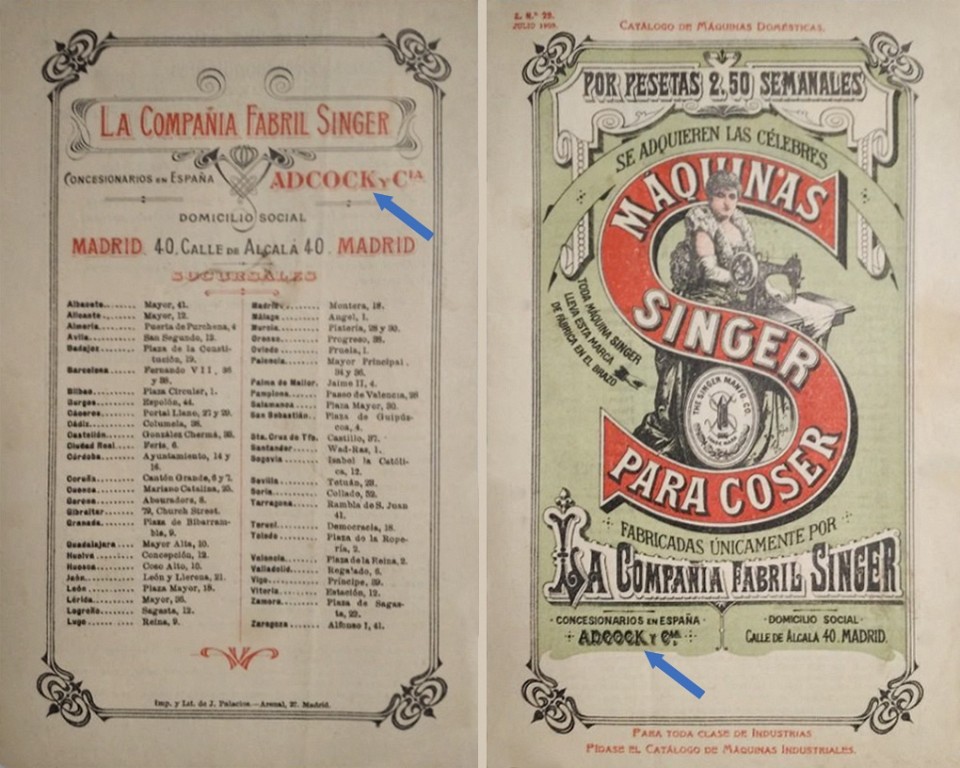
Figure 2:
Cover of a 1906 catalog in which "Adcock y Cía." appears as the Singer’s agent ("concesionario") in Spain
It was also decided that Singer Spain would have two-headed management: a young Cecil Phillip Adcock, Edmund’s son, aged 27, would initially oversee corporate strategy, and Pedro Velasco, a lifelong Singer man, would be in charge of its operational management, while also being the mentor to Cecil Philip until Cecil would become the sole affiliate’s manager a few years later. That year, 1907, net sales (gross sales minus repossessed machines) reached 44,313 units, still including the then modest figures for Italy, Portugal, and Malta.10
During the first decades of Singer's existence in Spain, its best-seller had been, as expected, the model ‘12’, which was gradually replaced by the model ‘15’ upon its launch. The model ‘48’—which was never able to compete with similar German machines—always had relatively small sales, as was also the case with the model ‘66’, the brand's flagship. So far, this was nothing that differentiated the Spanish company from the other foreign subsidiaries.
What did distinguish the Spanish affiliate were the negligible sales of all the vibrating shuttle models. For reasons which we have never understood, neither Singer nor any other competitor ever managed to sell machines of that type in significant quantities in the country.
The First Two Hexagon Models are Marketed in the Country
Under the good management of C. Adcock and P. Velasco, Singer's sales grew steadily: from 56,059 units in 1910 to 74,367 in 1916 (gross figures of imported machines plus repossessed machines).9
Cecil Adcock had been insisting throughout those years, in many communications with the executives in New York, on the necessity of having a competitively priced machine to face the strong German competition... and he had always been told by the management that “... this machine already exists, and it is the 48k.” There is no evidence that the previous ‘39-2’, also intended to combat low-cost competition, was ever marketed in Spain.
Therefore, when the launch of the Hexagon project was confirmed in 1916, Adcock was excited when reading the September 27 letter:
“The general idea will be to furnish four styles of machines which would correspond to our 28, 27, 15, and 16, in general form, but with such modifications as would make them quite distinct machines, and with parts that would not be interchangeable with our own.”4
They would finally have a complete range of low-cost sewing machines!
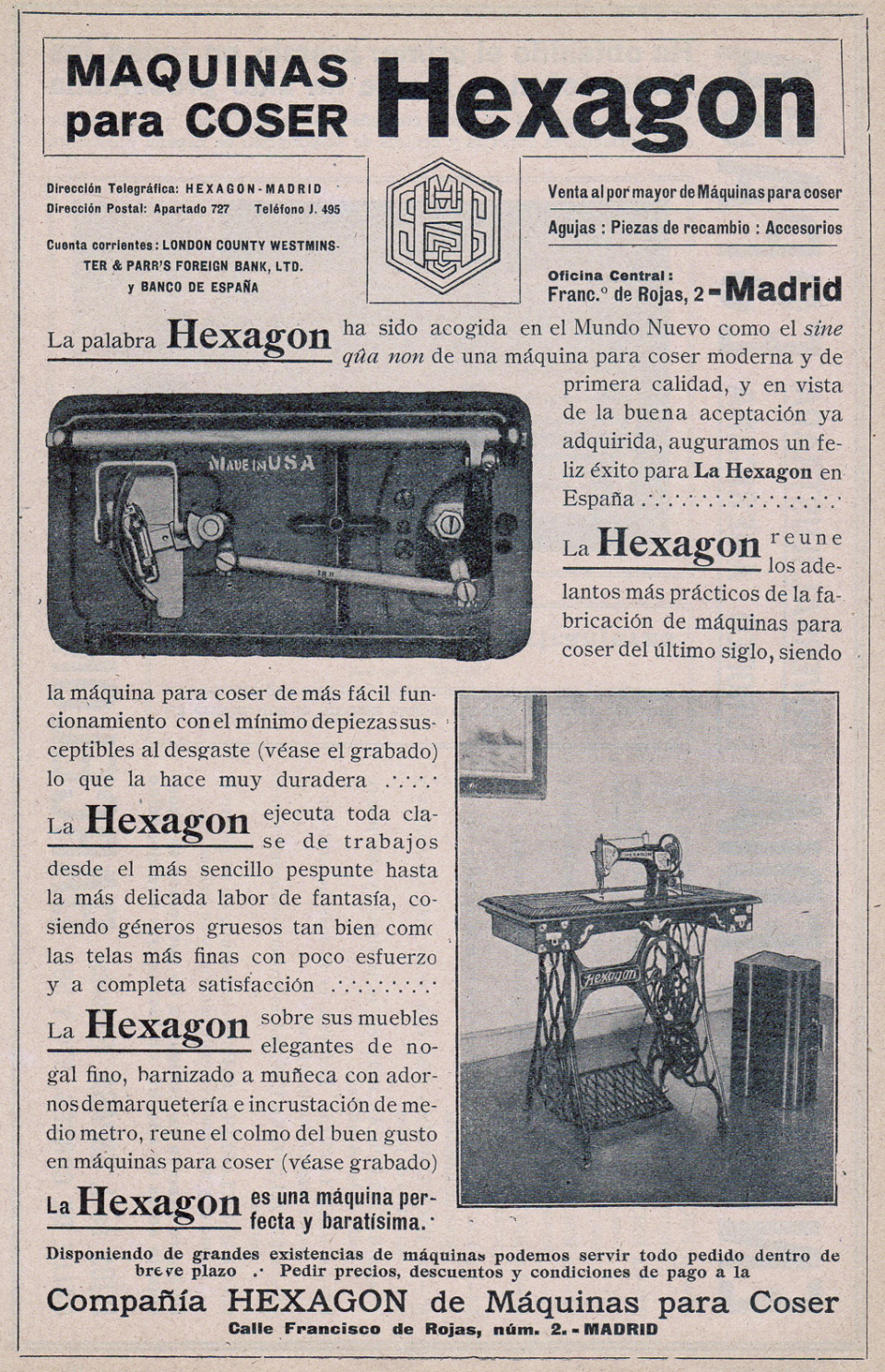
Figure 3:
‘Hexagon No.1’ Spanish advertisement
He must have felt less enthusiastic about the following paragraph of the same message:
“We have already prepared and approved a model of the 28 type, and that has gone over to Singer [the factory in Scotland] to have the necessary preparation for its immediate manufacture...”
Unfortunately, they were only going to have, for the moment, a single Hexagon model, of the much-reviled vibrating shuttle type. Following corporate instructions, the Spanish Hexagon company was immediately created. The new “Compañía Hexagon de Máquinas para Coser” opened offices and warehouses in Madrid, at 2 Francisco de Rojas St. (Figure 3).15
A certain Mr. Luther (who was none other than the Singer subsidiary’s accountant) was appointed as the new company’s manager, granting him the corresponding power of attorney.4 A network of dealers also began to be created, although it would never reach the necessary critical level. The most powerful among them was the Barcelona company “J. Puig de Abaria” who had branches and stores in several cities throughout the country (Figure 4).
As explained in the first part of this article, the first Hexagon No.1 (hex section arm) machines left Elizabethport at the beginning of 1917, initially to supply the South American market. It was planned that Clydebank would also manufacture Hexagon machines to meet European demand, but at that time—in the middle of the First World War—that factory was dedicated to other, less peaceful needs.
Cecil Adcock was, quite possibly, among all branch managers, the one who had most insisted on marketing a cheap competitive machine. And, as a result of so much insistence, he managed to have a batch of those new machines sent to the affiliate: in February 1917, a lot of 500 Hexagon No.1 machines left New Jersey for Barcelona.4
Adcock was aware that, to efficiently compete with the German (and also American) machines, they needed in Spain a cheap central bobbin machine, and already in May 1917, after receiving those first Hexagon No.1 machines, he wrote to N.Y.:
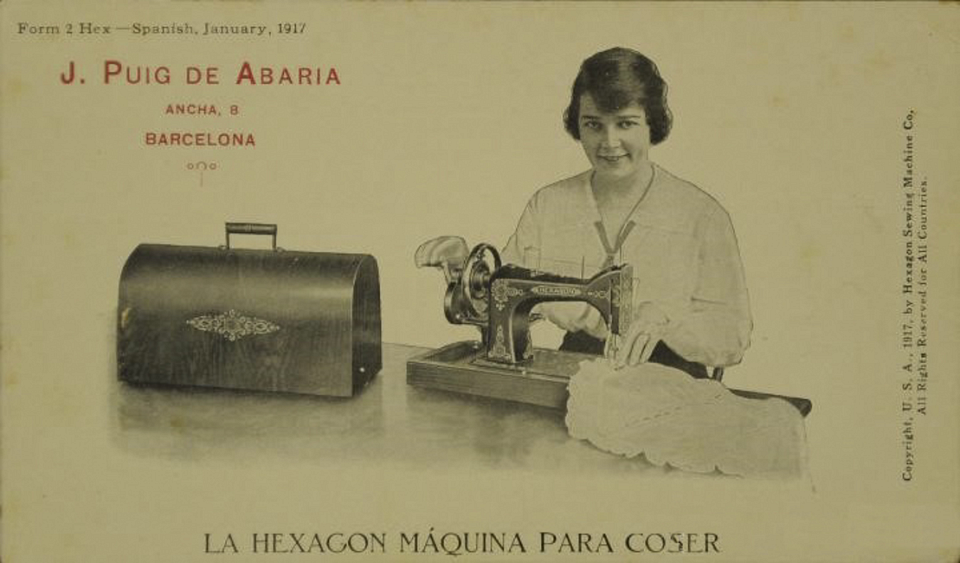
Figure 4:
The most common ‘Hexagon No.1’ ad, printed in the USA (with two translation errors in a single five-word sentence!), personalised for the “J. Puig de Abaria” local dealer
“I regret you are unable at the present moment, to supply us with a central bobbin machine as this is very essential ... and as the difference in selling price is considerable, there is naturally a greater demand for a central bobbin machine.”4
Knowing the bad reputation that vibrating shuttle machines had in Spain, the results did not surprise anyone: sales of the ‘Hexagon No.1’ were very low. We guess that those first 500 machines shipped in 1917 ended up being the only ones sold in Spain, and most likely, they were also the only units of that model that reached Europe.
In 1919, with the First World War over, production of the Hexagon sewing machine moved to the UK, and the Hexagon No.2 (circular section arm), manufactured in Clydebank, was finally marketed in some European countries, Spain among them.
Unsurprisingly, as it was another vibrating shuttle machine, this new model’s sales were as dismally low in Spain as those of the previous ‘No.1’.
The Third (and Fourth) Hexagon
Adcock was always insistent on a Hexagon version of a central bobbin machine because he felt that, with a full range of both Singer and Hexagon sewing machines, the two companies could even wipe the competition out of the Spanish market. On July 24, 1920, he sent this message to company headquarters:
“I fully realize your point of view in this matter, but at the same time I very much regret that you are unable to supply some sort of Central Bobbin Hexagon Machine to meet my wishes, for I am perfectly certain that at the present moment, with a little careful manipulation of both companies, we could create a monopoly of the entire Spanish market.”4
A year later, on June 22, 1921, Adcock, without having meanwhile obtained acceptance of his repetitive request and increasingly belligerent, wrote once again to New York:
“We recently had the visit of Mr. Bullock in Paris, and whilst discussing Hexagon matters in a general way, he gave me to understand that the Company had abandoned the idea of manufacturing a Central Bobbin machine, but he could not inform me whether this policy was applicable to all countries or merely to Great Britain and France. ... I think it would be a good idea to close up the Hexagon business in Spain entirely, for I am now convinced that with only the small machine [the No.2] we shall never be able to compete with the German manufacturers.”4
The immediate response from the headquarters was not very encouraging for him:
“... we have decided that it would be unwise to incur the very large additional initial expense which would be rendered necessary by the decision to manufacture a Central Bobbin Machine for Hexagon.”4
But Cecil Adcock, in a cable dated July 26 that same year, responded by proposing a solution he believed was feasible:
“I think it would be a good idea if later on through the Hexagon Company we were able to offer a Central Bobbin machine at a price which would give us a profit, and then see what number of machines would thus be ordered. If the ordered were few, we could supply Singer C-B machine with the name altered, and close the matter entirely.”4 That is to say, he was once again proposing the marketing, under the Hexagon brand, of a cheap central bobbin machine but, reading his message, one could theorise that this time he was thinking of a machine not necessarily manufactured by Singer.
At that time, the general figures of the Spanish subsidiary were excellent: sales had been growing until reaching a gross maximum of 95,170 machines in 1922,12 a number that placed the Spanish subsidiary as the fourth in the world, not far behind the three largest: UK, Germany, and France. With that cheap machine so repeatedly requested, Adcock dreamed of placing the Spanish subsidiary as the second, or even the first, but things did not happen as he expected, and that peak was going to be historic: Singer would never again exceed that sales figure in Spain.
For a year, Adcock's request was not met, but in the summer of 1922, the senior managers of Singer/Hexagon finally gave the green light, but in a very conservative way: it was decided to produce the central bobbin Hexagon model in Clydebank, yes, but as explained in the Part 1 of this article, the new Hexagon No.3 would be nothing more than a minimally modified ‘Singer 15’ and, consequently, in the same cost range.
Adcock was convinced that a machine with both functionality and price similar to the ‘Singer 15’, would cause the Spanish subsidiary not only to fail to gain market share but even to cannibalise the 15's own market. If, as we suspect, the affiliate was also forced to import a significant number of ‘Hexagon No.3’, without waiting for its eventual success, it is assumed that Adcock, of strong personality, became enraged. What happened next was not surprising.
Cecil P. Adcock's position within Singer had always been very powerful as evidenced by his very high income, but his continuous demands and his temperament had earned him the antipathy of the company's directors. Douglas Alexander, then Singer’s Chairman, had written about Adcock: “He apparently still considers himself to be a very much injured and under-paid man and has a very exaggerated view of what he has accomplished for us.”4
The situation became then unsustainable, and Adcock finally resigned at the end of 1922. Somehow, Adcock's wife, Violet Marianne, née Bartholomew, ended up involved in the situation and it is very peculiar to read the message that Singer's senior managers sent to her:
“... he has taken an absolutely impossible position from which he has given no indication of a desire to retreat. ... In view of his complete dissatisfaction it would be unjustifiable to ask him to return even if that were now possible. ... he was also dissatisfied with his salary, a princely amount, much larger than is being paid to any one [sic] else outside of this office.”4
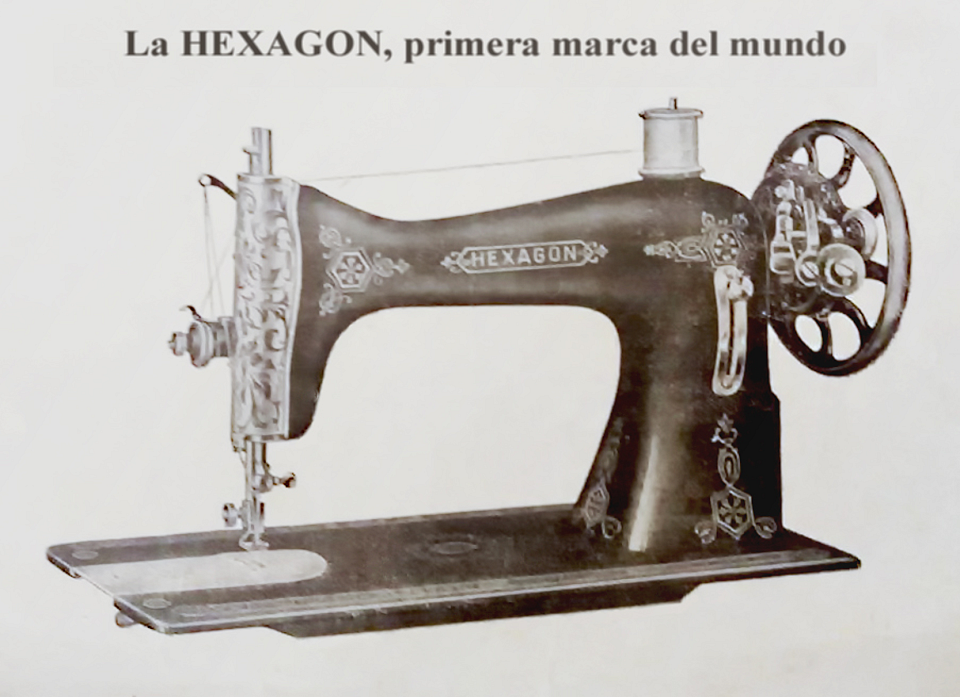
Figure 5:
The ‘Hexagon No.3’ as pictured in a Spanish brochure of the time
The ‘Hexagon No. 3’ was finally launched in Spain (also in France, Italy and, most likely, some other European countries, as well) in the second half of 1922 (Figure 5). It was usually only called ‘The Hexagon’ in Spain, sometimes ‘Hexagon No.3’ or even, by mistake, ‘Hexagon H.23’ (as that was the manual’s form number!) (see Figure 6).
In the advertisements of the time, this machine was never directly associated with the Singer company—nor had been the other two previous models—but its origin was clearly suggested with sentences like these (translated from Spanish):
“The Hexagon Sewing Machine Co. Ltd. is the most powerful company dedicated to the production of sewing machines, ... More than a million machines are produced each year from its factories, located in Scotland.”5
You didn't have to be very clever to figure out which company manufactured the machine! Despite this publicity, just as Adcock had feared because of its uncompetitive price, the third of the Hexagon sewing machines was also a failure, with only a few thousand being sold in the country. This led, at the first half of 1924, to the definitive closure of the Hexagon Sewing Machine Company in Spain. Combined with disappointing sales in UK and other countries, by the beginning of 1925 the entire company was in liquidation.
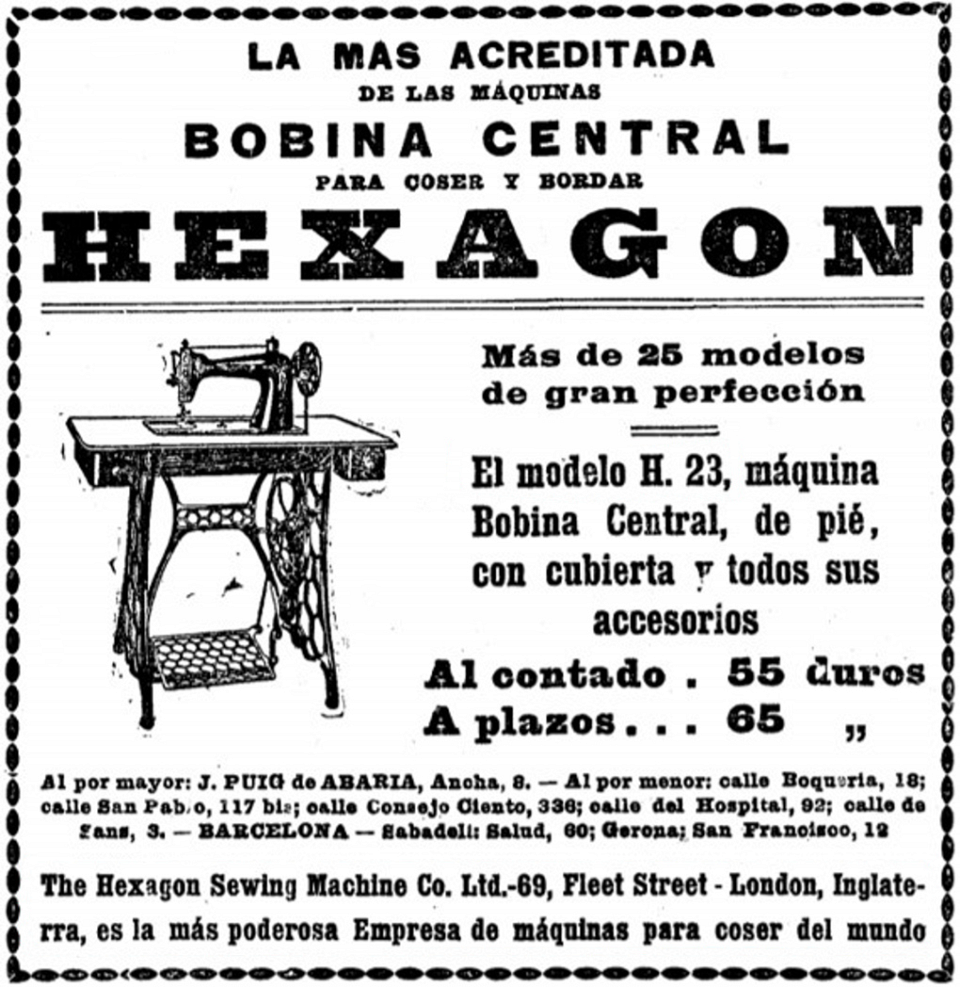
Figure 6:
An advertisement for the ‘Hexagon No.3’, surprisingly called here the ‘H.23’ (La Vanguardia Española, January 1923)
Regarding the Hexagon No.4, manufactured in so small quantities, as explained in Part 1 of this article, we have found evidence that it was marketed in France and Italy, but not in Spain.
Cecil Adcock, who had been born and lived all his life in Madrid, then bought at auction, for the sum of £17,250, a mansion (called "Grenehurst Park State") in Capel, Surrey (UK), to which he moved in 1924 with his family.
He died there in 1940, aged only 60. But the family misfortunes did not end there: two of his sons, Reginald and Douglas, both RAF pilots, were killed in combat action during the Second World War.
End of this story? No! The most successful Hexagons are yet to come!
Singer in Spain, Between 1923 and 1948
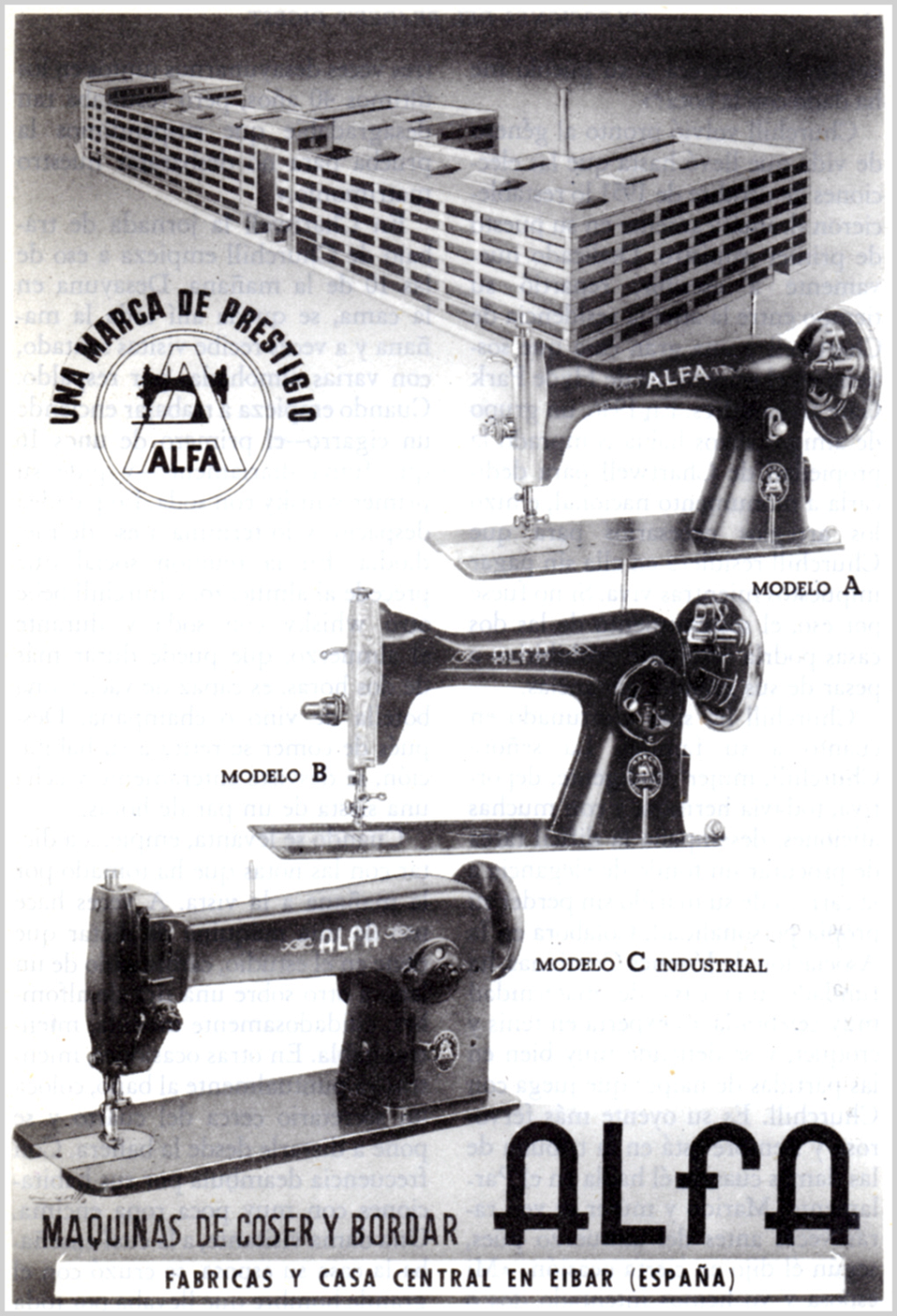
Figure 7:
An advertisement from the mid-1940s picturing the Alfa factory, its then only two family machines, models 'A' and 'B', as well as the 'C' industrial machine.
Cecil Adcock, upon his departure, must have cast a curse, or more likely, his influence on the company’s management, and his strategic vision had been much greater than had ever been believed at the New York headquarters: without him, Singer’s figures in Spain began to steadily decline, reaching only 26,961 units sold in 1935.12
But the worst was yet to come: the Spanish Civil War broke out in 1936 and sales plummeted, with a measly 72 machines (all refurbished) resold in 1940, the year after that war’s end.12
During the Second World War, with Franco's Spain aligned with the Axis, the import of new sewing machines was a pipe dream, yet, after its end in 1945, the situation did not improve. By then, Spain had become a “pariah” country, isolated from the world and without any possibility of importing sewing machines or any other manufactured goods.
During the 1940s, Singer's “sales” in Spain stuck between 5,000 and 6,000 machines per year, all of them repossessed from delinquent contracts.11 With those meagre figures, the company was heading towards its demise. It was only kept alive by the recurring collection of the contracts still ongoing.
Singer's only hope of having new machines was to manufacture them in Spain, but circumstances made this seemingly impossible: neither was Singer going to invest in a new factory in Spain, nor was the Spanish government going to facilitate it, even if the company wanted to do so.
At the end of 1948, Singer’s new general manager in Spain, Mariano Cid Manzanedo, who had held the position since October of that year, concluded that, if they could not manufacture new machines in Spain, they could find someone to produce those machines for them!
At that time, in the late 1940s, there were three Spanish companies manufacturing sewing machines.
The first was Alfa, a firearms manufacturer from Eibar, in the Basque Country, which, since 1926, had successfully manufactured a class 15 clone, the ‘Alfa A’ model, which they later developed into the very similar ‘Alfa B’, equipped with reverse feed (Figure 7).14
Figure 8:
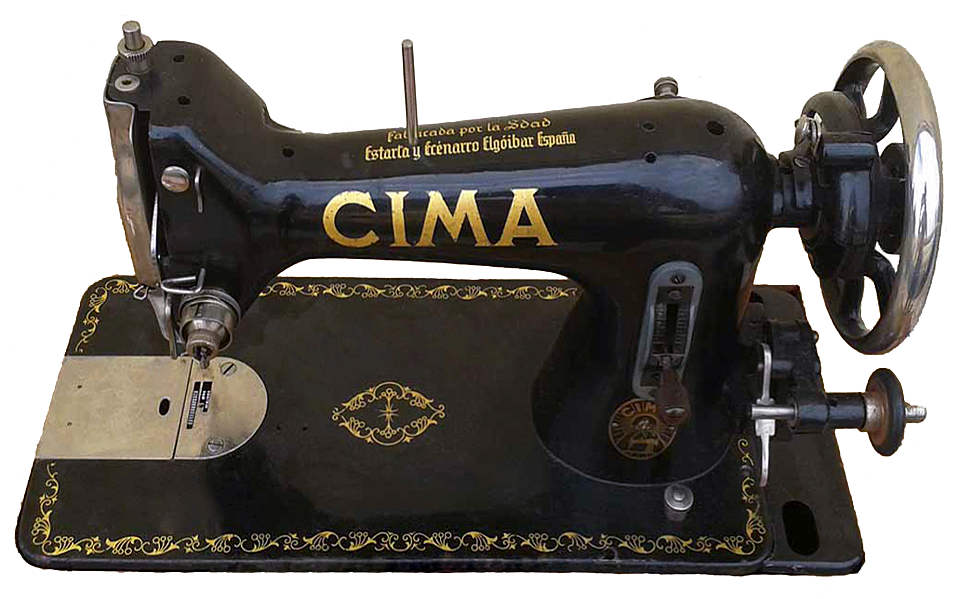
The 'Cima 100', manufactured by Estarta y Ecenarro between 1943 and 1944
The second was Estarta y Ecenarro (EyESA), a machine tools manufacturer, which in 1942 had managed to acquire, from the German company Mundlos, the licenses, machinery, and tools related to its ‘115’ model.18 They had been manufacturing this machine since 1943 as the ‘Cima 100’ model (Figure 8) at its factory in Elgóibar, also in the Basque Country, just 10 kilometres from Alfa. As a result of the lawsuit filed by the Swiss firm Tavannes Watch, manufacturer of "Cyma" watches (due to the similarity of both brand names), EyESA was soon forced to replace the Cima brand with a new one, ‘Sigma’; the sewing machine model was consequently renamed ‘Sigma A’.
In 1948, Alfa and EyESA had their resources fully occupied with the manufacture of their own sewing machines, so they rejected the proposal to produce machines for Singer.15
The third option was a company from Barcelona called Rápida.
From Wertheim to Rápida S.A.
The German Josef Wertheim had emigrated to the United States in the 1850s, and reportedly worked some years for Singer while there. Upon his return to Germany, in 1863 he opened a small workshop in Frankfurt am Main to produce sewing machine components. In 1868, Wertheim moved to another building with its own foundry, thus becoming a complete sewing machine manufacturer.13
With a wide range of machines and a fairly efficient manufacturing process (by the standards of the time), the company became, by the end of the 19th century, one of the largest German producers, if not the largest.
In 1876, the company opened its first foreign subsidiary, in Barcelona. Apparently, J. Wertheim's father-in-law, David Ballin, a textile merchant, maintained a very good commercial relationship with some Catalan businessmen, who convinced Wertheim of the economic potential of a Catalonia, then at the dawn of its industrialisation, with textile manufacturing as its spearhead.
The performance of the Barcelona branch was acceptable enough to keep it operational for the next decade.
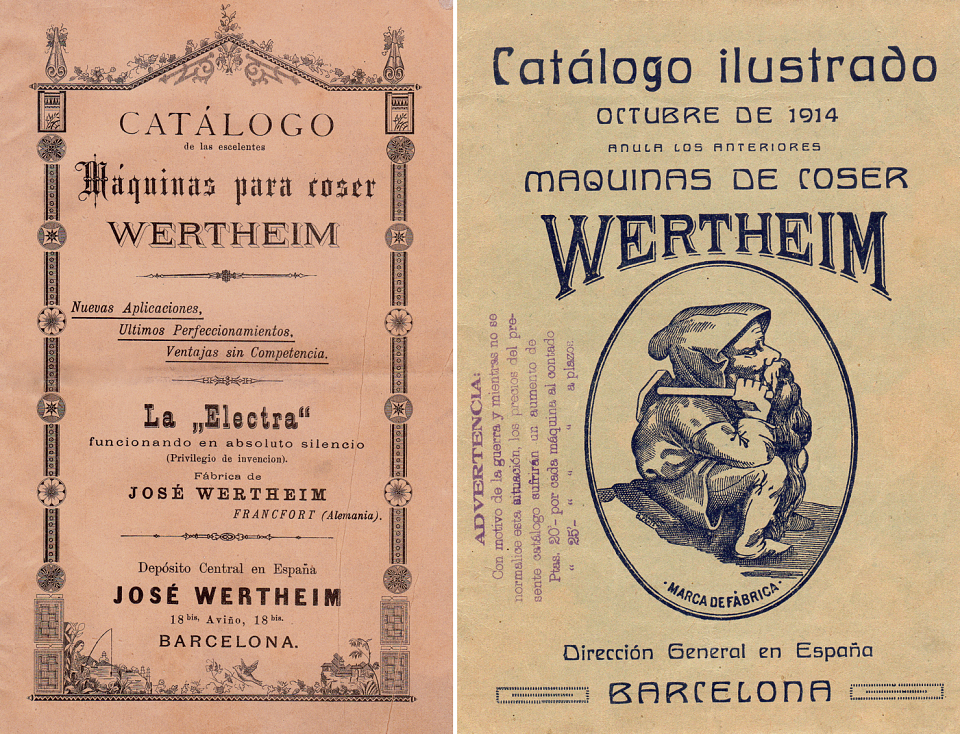
Figure 9:
Two Spanish Wertheim catalogues: from 1895 (left), and from 1914 (right)
In 1888, when a new Universal Exhibition opened in Barcelona, Josef sent to that city, as the company’s representative, the fifth of his ten children, Karl Gustav, then only 20 years old.13 The young man worked there to boost machine sales and made good contacts during the months of the exhibition. Throughout the following years, he continued to travel regularly to Barcelona, and around 1895, he settled permanently in the city.
The Spanish branch of Wertheim, which had been selling only the parent company's sewing machines under the impetus of Karl Gustav (soon known as Carlos Wertheim), began to sell other products not manufactured by Wertheim, such as bicycles, outboard motors, and even beer dispensers! But Karl/Carlos was going to undertake more ambitious steps that he knew could end up putting him at odds with his own family. And so he did: to complement the range of Wertheim machines (and to not become excessively tied to the family strategy, by the way), Carlos decided to start selling sewing machines from other manufacturers.
At first, some types of machines that had no equivalent in the company's range (such as the capability to stitch elastic, fur, etc.) were introduced in the Barcelona Wertheim catalogue, but around 1905, it also began to include machines in direct competition with those of Wertheim, manufactured by companies such as Gritzner, Kochs Adler, Baer & Rempel, National, White and others.
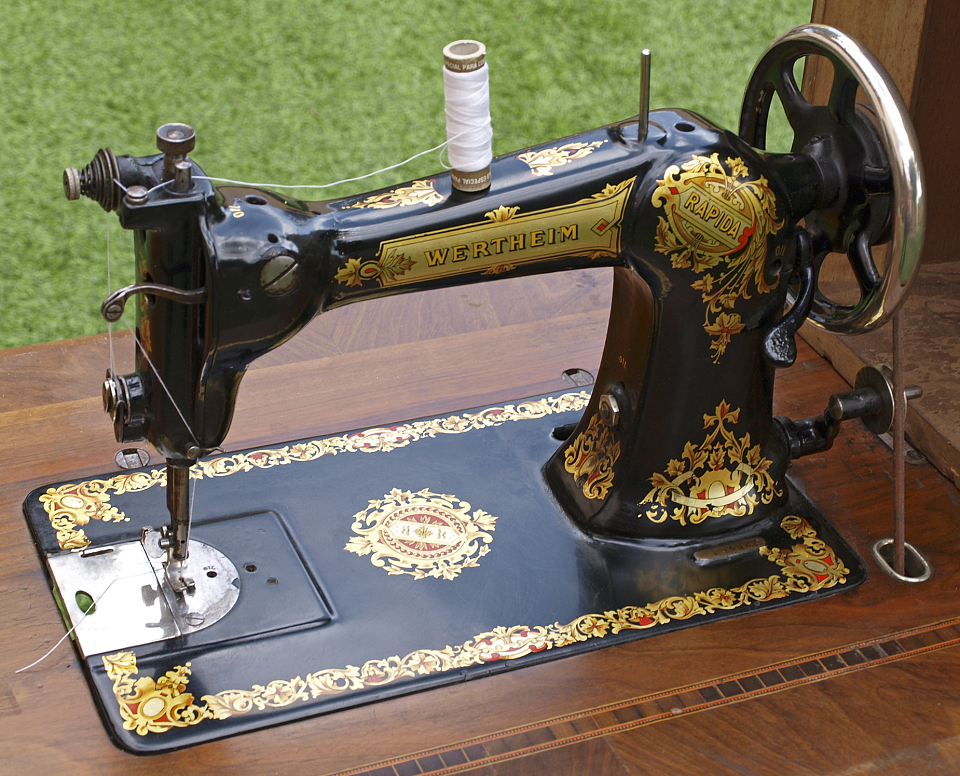
Figure 10:
A Wertheim ‘Rápida’ (serial 194821), ca. 1928
Furthermore, Carlos Wertheim had been granted, years previously, the exclusive distribution of Wheeler & Wilson nationwide (although he had always kept that brand's network of agents separate from Wertheim's). When that company passed into Singer's orbit (and Singer, in 1906, terminated its contract with him), Carlos had to look for a replacement for the ‘W&W 9’, a model that had been quite successful. At the end of 1906, he reached an agreement with the English company Jones to sell in Spain its rotary shuttle model, the ‘Jones Spool’, under the Wertheim brand. It was called ‘Rápida’ (the Spanish word for “Fast”). The long-lasting success of that ‘Wertheim Rápida’ machine was going to be enormous (on a Spanish scale): between 1906 and 1936 some 120,000 were sold (Figure 10).
Along with that model, the Barcelona Wertheim’s other perpetually best seller was a model that Wertheim manufactured in Frankfurt: the central bobbin machine, a clone of the ‘Singer 15’, which will have great importance in this story.
Given the ‘Wertheim Rápida’ success, when, in 1920, Carlos Wertheim decided to create his own independent company, he did not hesitate to name it Rápida S.A. (Figure 11).
Meanwhile, his relationship with his family had become very strained (having a daughter, as a result of an incestuous relationship with his niece, Ilse, hadn't helped much either!, as explains Wertheim’s grandson, Carlos Guilliard, in his book).13 To further distance himself, Carlos changed his name: legally he became Carlos Vallín, although he always kept the Wertheim brand name on his machines.
Rápida’s Evolution, Until 1948
During those years, Rápida’s sales had already clearly surpassed Singer’s in Spain (a company immersed in its own difficulties, as explained above) and had become the country’s market leader, a position kept until the Spanish Civil War (1936).
In 1929, Rápida expanded and modernised its foundry and soon gained an excellent reputation due to the high precision of the parts it manufactured. One of its first clients was a neighbouring company, Hispano Olivetti, founded that same year, with 50% of the capital in the hands of Camillo Olivetti, founder of the Italian firm Olivetti, and the other 50% held by some Catalan businessmen (mainly Julio Capará, who few years later would be also involved in the foundation of Elna S.A., the first company, before Tavaro, to manufacture sewing machines of that name).2 The objective of Hispano Olivetti was to produce, under license, the typewriters developed by its Italian partner.
The trajectories of Rápida and Hispano Olivetti would end up completely converging a few years later.
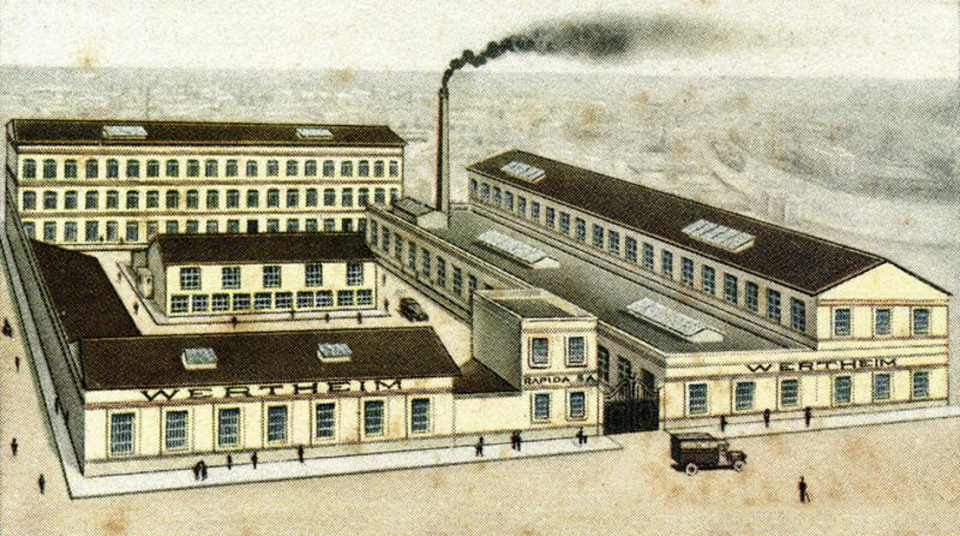
Figure 11:
The Wertheim / Rápida factory in the early 1920s
Meanwhile, the activity of the German company Wertheim had been gradually languishing due to its, by then, obsolete, and uncompetitive products. This negative development added to what was already seen as an imminent seizure of power by the Nazis, something that greatly worried the Wertheims—who were Jewish—and led the family to the decision to close the Frankfurt factory in 1932.
Karl Wertheim / Carlos Vallín, who had approached his family again in the last few years, decided then to acquire the machinery, tools, fixtures, jigs and parts related to the production of the class 15 central bobbin machine (it never had a specific name), which actually was the only moderately competitive product still manufactured in the Frankfurt factory prior to its closure. His goal was to continue manufacturing it in Barcelona and, to do so, he moved all that equipment to the Catalan capital. That decision would eventually become the key that gave rise to the Spanish Hexagon sewing machines.
The process of moving and starting up the full production line was much more laborious and lengthier than he had anticipated, and the results were very disappointing: between 1933 and 1936, only about 5,000 units, at most, were manufactured (Figure 12).
In July 1936, the Spanish Civil War broke out, and Catalonia, which remained under government “control,” also plunged into a revolutionary process that ended with the murder of many businessmen, the exile of almost everyone else, and the collectivisation of most of their companies. Carlos Vallín, who initially stayed in Barcelona, watched as his company was requisitioned and he was dispossessed of his assets, although his life was saved by his own workers, thanks to the good treatment he had always given to them.16 After its collectivisation, the company was renamed “Colectividad Obrera Wertheim Rápida CNT-AIT” (that “CNT-AIT” was a very powerful anarchist armed union) and during the war the factory was dedicated mainly to ammunition manufacture.
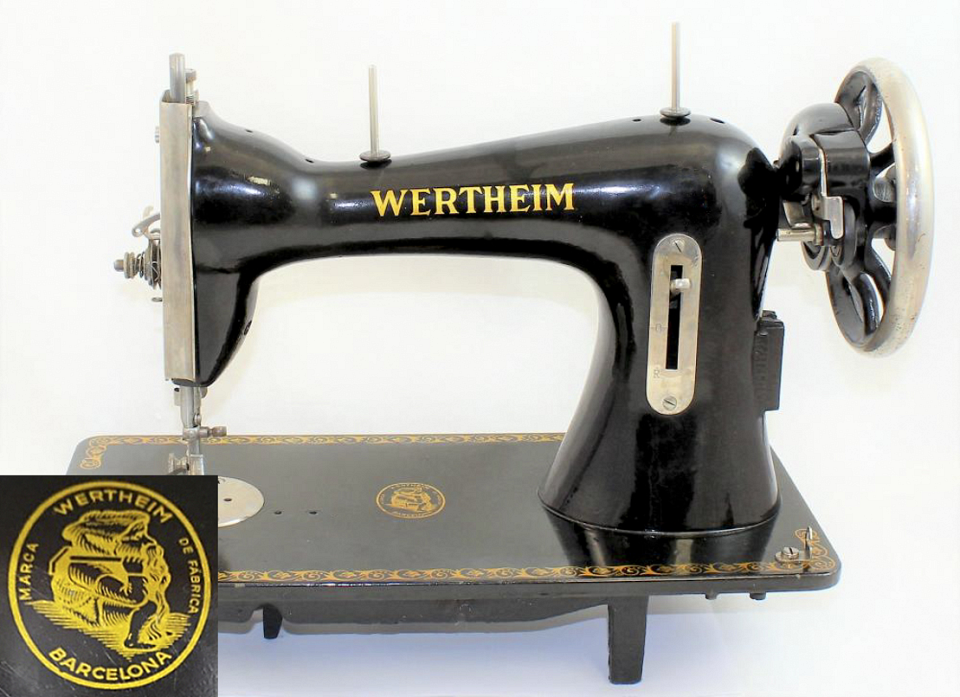
Figure 12:
A central bobbin Wertheim machine, manufactured in Barcelona ca. 1936, with permission from “Antiguitats El Drac” (notice the decal badge)
In April 1939, the war ended, leaving a destroyed and impoverished Spain, with much of the industry devastated, with hundreds of thousands of people dead, and hundreds of thousands more fleeing into exile. In a Barcelona that had been repeatedly bombed by fascist aircraft, it was a true miracle that Rápida’s factory had remained intact until the end of the war.
With the war over, Carlos Vallín immediately regained ownership of his company and attempted to relaunch the business. Since importing sewing machines was impossible, the only option to have new machines to market was to manufacture them again. But this was going to become a titanic task: the Second World War had broken out, the country was closed to any type of import of machinery and capital goods, and General Franco's government strictly controlled and rationed the use of fuels and raw materials of all kinds. Furthermore, many skilled workers had died, and many others had fled abroad, but most importantly, the goal of many people was simply to survive, and they could not devote their very limited resources to the acquisition of a sewing machine.
Even so (he was a stubborn man), Vallín / Wertheim undertook the relaunch of production, and even an important expansion of the factory,3 but before long, already 75 years old, ill, and with insufficient financial resources, he became convinced that this project far exceeded his physical and economic capacities.
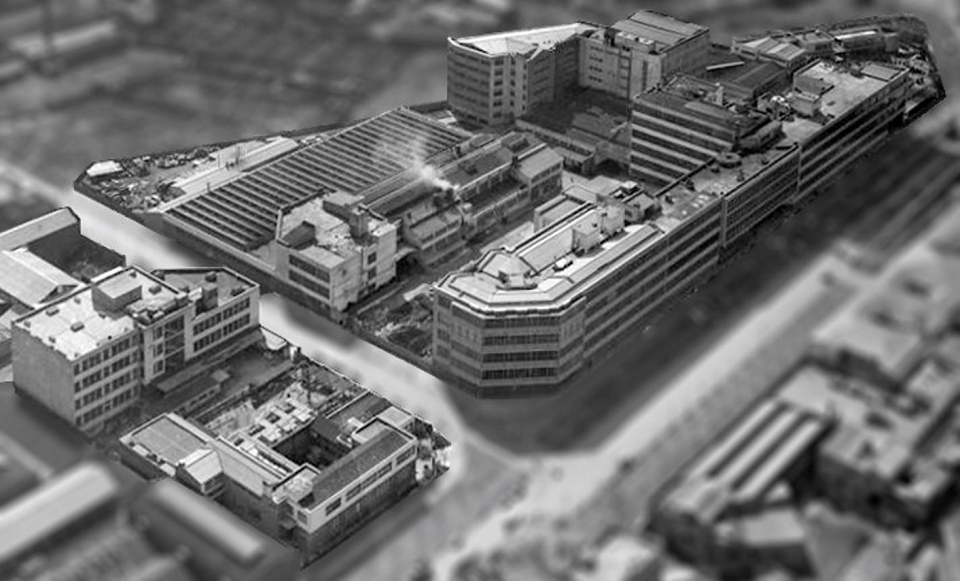
Figure 13
The Hispano Olivetti and Rápida joint factory, in the mid-1950s (with its surroundings deliberately blurred). In the upper right corner, the swimming pool and sports courts; below, in the foreground, the school and daycare. The smoke from the foundry, in the centre, fades above the very large refectory. (with permission from Arxiu Nacional de Catalunya)
Hispano Olivetti, a company then pampered by the Franco regime because of its excellent relationship with Fascist Italy, observed with great concern Rápida’s deterioration process, since many of the parts of its typewriters were manufactured by that company, and its eventual closure could endanger H. Olivetti itself. Finally, at the end of 1942, the Hispano Olivetti’s shareholders decided to acquire the majority of Rápida's capital, thus ensuring its continuity and avoiding, in extremis, its imminent closure.1 From that moment on, Rápida would always be largely controlled by the Hispano Olivetti’s shareholders, although, strictly speaking, it was never a subsidiary of that company.
At the same time, Franco's Spanish government, supported by its Italian ally, had decided to turn Hispano Olivetti into a model of the “new Spanish company”, and to achieve this, the resources that others found so difficult to obtain were made readily available to the company. Thus, in 1942, the construction of a new and large factory was undertaken in Barcelona. In line with the deeply human, social, and progressive sense that Camillo Olivetti inspired in all his business initiatives, the new factory had social facilities that were then very scarce in the country (swimming pool, sports courts, school, daycare, kitchen, refectory, store, clinic, etc.) (Figure 13). In 1943, its first phase was already operational, and immediately, the central bobbin sewing machine manufacturing was transferred to it (both factories were in close proximity). With the company well supported with all kinds of resources, its manufacturing soon reached a minimum acceptable pace: about 10,000 units per year.1
Three decades later, in the early 1970s, this factory would become the largest manufacturer of mechanical typewriters in the world… unfortunately, just as those typewriters were being replaced by new technology equipment everywhere!
As a result of the move, only the foundry remained operational in the old and small Rápida factory, which continued producing parts, both for sewing machines and typewriters, during the following years.
Also in 1943, it was decided to replace the only (and obsolete) sewing machine then in production: the class 15 clone would be superseded with a more modern machine, developed in-house, although “inspired” by some machines of the Italian firm Vigorelli. It would be called ‘RBC 43’ (“RBC” for “Rápida Bobina Central”, and “43”, obviously, for the year the project started) (Figure 14).
Given the country's limitations, the new machine’s development and launch ended up leading, as expected, to a very long process: the first machines did not leave the Barcelona factory until 1948.
The new ‘RBC 43’ should have meant the end of the old central bobbin machine's production but, unexpectedly, the urgent needs of a large American company (can you guess which one?) were going to extend its life some more years.
Meanwhile, Karl Gustav Wertheim, alias Carlos Wertheim, alias Carlos Vallín, an outstanding figure, had died in Barcelona on August 22, 1945.5
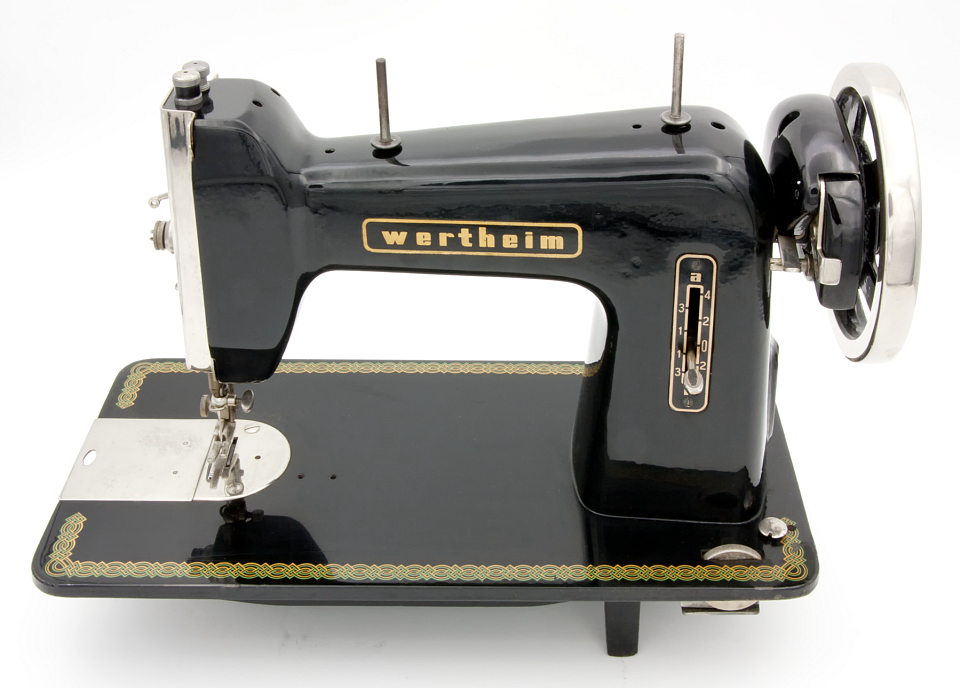
Figure 14:
The "Wertheim RBC 43" was manufactured by Rápida between 1948 and 1957 (this one, serial 211362, manufactured in 1956)
The Fifth Hexagon Speaks Catalan
When, at the end of 1948, the then general manager of Rápida S.A. (we have not been able to find his name) met Mariano Cid, his Singer counterpart in Spain, the request he heard must have sounded to him like heavenly music. Indeed, Cid was asking Rápida to manufacture class 15 sewing machines for Singer... while Rápida’s production line of its phased-out machine of that class (replaced by the new ‘RBC 43’) was then unused and completely available.
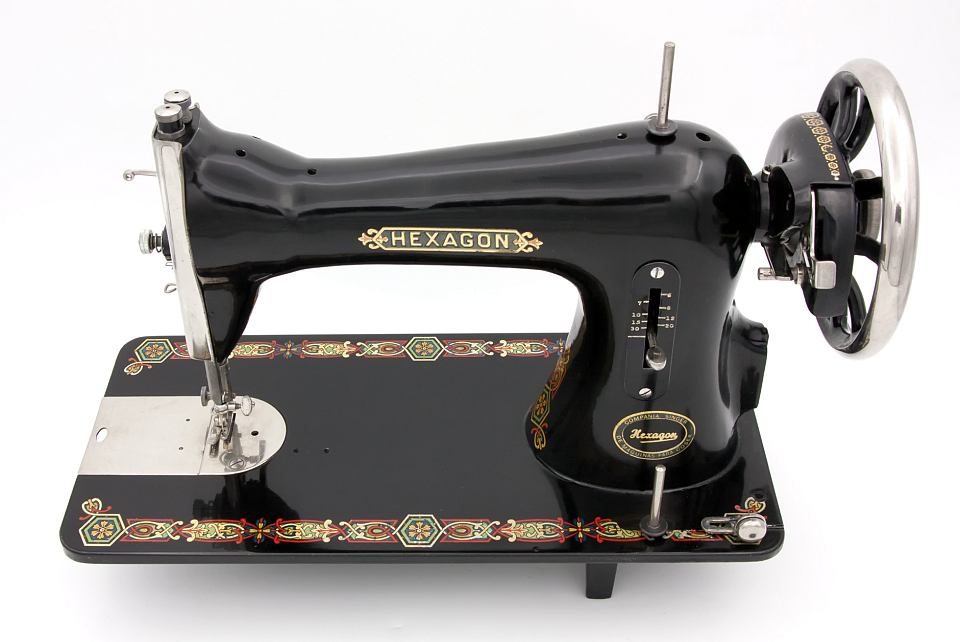
Figure 15:
The ‘Hexagon’ (later called model ‘A’), serial H 20903, manufactured in Barcelona, by Rápida, in 1951
The machinery and tools to produce that old machine, although largely depreciated (most, as explained, had come from the old Frankfurt factory), were still fully functional. There would also be no problem in simultaneously manufacturing both the ‘RBC 43’ and a machine for Singer since, in the constantly expanding factory shared by Rápida and Hispano Olivetti, there would be more than enough room for two operative production lines. Furthermore, the start-up of a new and very capable foundry was imminent, which was going to replace the previous one, located in the old Rápida factory.
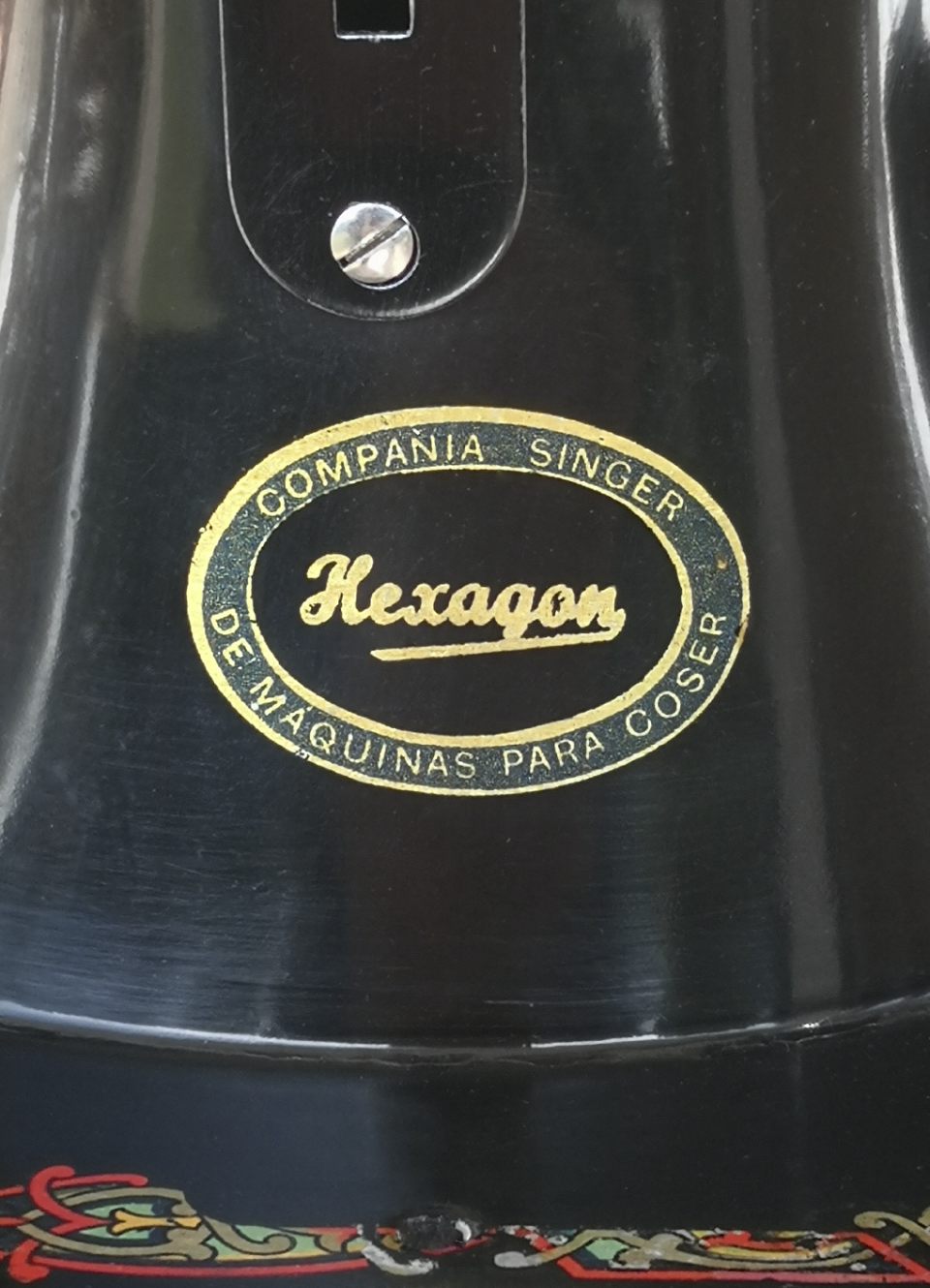
Figure 16:
The decal badge applied to all the Hexagon sewing machines made in Barcelona (notice that “Compañía Singer de Máquinas para Coser” [Singer Sewing Machine Co.] around it)
Although the agreement between both men was instantaneous, authorisation of the government (that controlled all economic matters) and approval of the Singer corporation were needed.
The government's authorisation was immediate: a large American multinational begging a Spanish company to manufacture sewing machines for them? Approved!11
Getting corporate approval was a bit harder. To Singer’s high management, the idea of manufacturing machines in Spain seemed unquestionable (otherwise, the company's evolution inevitably would lead to the liquidation of business there), but they did not want to see its name associated with a country then isolated from the rest of the world and whose government was branded as "fascist.” Nor did they want to compromise their brand’s good reputation with a machine manufactured by a Spanish company, whose production they could not effectively control and whose final product could be of questionable quality.
Someone then remembered the old Hexagon brand. When it was found that Singer had kept ownership of both the brand and its various trademarks since the liquidation of that company in 1925, all the managers involved in that process then realised the solution: Hexagon was going to be the new Spanish machine’s brand name!
The Singer corporation then transferred the Hexagon brand’s use to its Spanish subsidiary which, in turn, commissioned Rápida to manufacture the “new” sewing machine.6 It also required the replacement of some original Wertheim elements (bobbin winder, thread tension assembly and some other minor parts) with others of Singer origin, whose manufacture was also licensed to Rápida.
Compared to the Wertheim machine previously manufactured by this company, the “new” Hexagon (as it was simply called, without a specific name) (Figure 15) differed in the elements mentioned above, in some small modifications to the machine’s arm, and, obviously, in the ornament set (a simplified version of the one used with Hexagon machines in the 1920s).
Although it was certainly an old-fashioned machine, it was still competitive in the cut-down Spanish market, so the Hexagon was comparable to the ‘Wertheim RBC 43’, ‘Alfa A/B’, and ‘Sigma A’; the only family machines that could be purchased as new at that time in Spain.
Manufacturing started immediately, and the first Spanish Hexagons left the Barcelona factory as early as the first quarter of 1949. Their serial number, starting at 1, were preceded by a "H" (e.g.: H 82370).
By 1958, some 115,000 units were manufactured, with an undetermined number being exported to other countries: Turkey (we have evidence of a 2,000-unit lot exported there in 1957)4, France, Argentina, Chile...
So, the most successful Hexagon model was not manufactured in Elizabethport. Nor in Clydebank. The most successful Hexagon model, by far, was manufactured in Barcelona, with probably many more units of that model produced than the rest of the models combined.
Unlike what had happened in the 1920s, this time, the Hexagon machine was always clearly associated with the Singer company, as proven, for instance, by the machine's decal badge (Figure 16) and by some brochures (Figure 17). It was a (not so) secret Singer sewing machine!
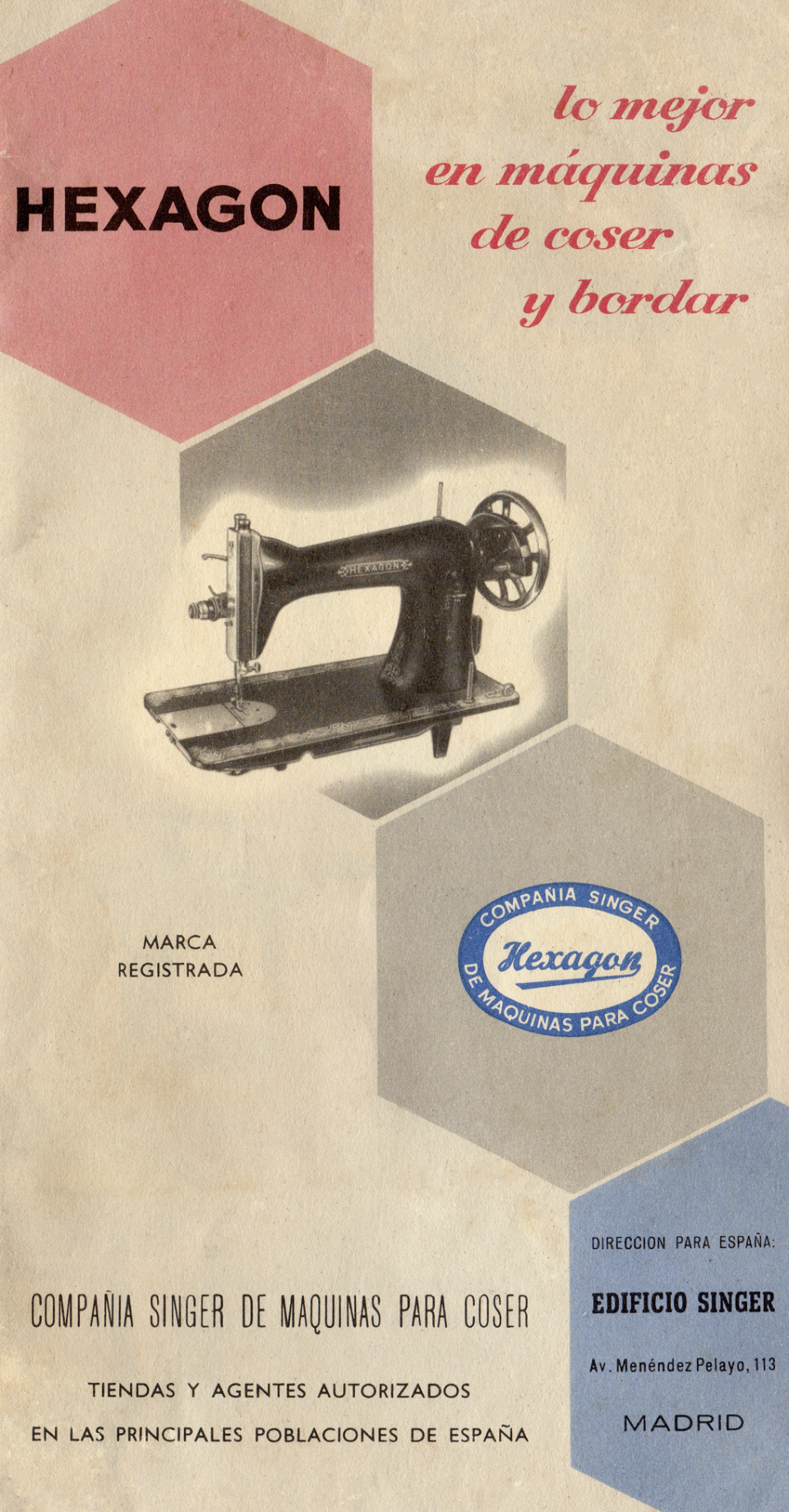
Figure 17:
Brochure of the Hexagon sewing machine, not yet identified as model ’A’
The Sixth and Last Hexagon
At the end of the 1950s, Spain began to enjoy a certain economic growth, and a part of the population could then demand more advanced products.
Meanwhile, the Spanish market had remained closed to the import of sewing machines: numerous tariffs, import quotas, and other difficulties were imposed in an attempt to protect Spanish manufacturers. Without any foreign competition, each of them evolved in their own way until achieving a complete range of more modern and complex machines.
The largest manufacturer, Alfa, had modernised its straight-stitch models and began then to market its own new automatic and zigzag machines.14
The second largest, Sigma (EyESA), had purchased, in 1958, the sewing machine business of the German firm Zündapp. This added excellent zigzag and automatic machines (although of questionable aesthetics) to Sigma’s line. EyESA would quickly improve all those models.18
They had been joined, since 1948, by a new actor, Refrey (Industrias P. Freire S.A.), based in Vigo, on the Galician Atlantic coast. Mainly oriented to the industrial market, at the end of the 1950s, they offered several family machines, developed from some licensed Bernina models.
Rápida, for its part, was then at its best and offered, always under the Wertheim label, three machines of different levels: the ‘BR’, a straight stitch machine developed in-house, and two more machines manufactured under license from Necchi: the zigzag ‘BZ’ and the automatic ‘AZ‘ (equivalent to the ‘BU Mira’ and ‘NA Nora’ from the Italian firm).
To face all this competition, Singer only had the old Hexagon/Wertheim machine, and was once again on its way to becoming a residual company in Spain.
Singer's managers were not willing to accept this, nor were they willing to abandon a market that, as was already perceived at that time, would grow dramatically over the next decade.8
Singer’s subsidiary, which was still managed by Mariano Cid, moved forward in two directions, bringing rise to the Spanish 800 series, a story as interesting as it is unknown, which would last until the 1990s.
On the one hand, negotiations began in 1958 for the licensing, to some of its Spanish competitors, of three Singer models (which would be called ‘1960 and 1970’, ‘801z’, and ‘827z’), to be manufactured by them, but marketed only by Singer under its own brand.
On the other hand, Singer also agreed with the Spanish manufacturers to the resale, by Singer and under the Singer brand, of several models designed and manufactured by these competitors. These same models would also be marketed by those firms with their own branding. Over time, there would be up to thirteen different Singer models of this kind (‘801z2’, ‘810z’, ‘807’, ‘815’, ‘817’, ...)
During those years, another 800 series was also produced in Argentina, unrelated to the Spanish one (models ‘802z’, ‘812’, ‘822’, ‘832’, ‘842’, and ‘874’).
These two initiatives would take months to carry out, and in the meantime, there was something more urgent to resolve: the immediate replacement of the archaic Hexagon/Wertheim machine with a new, more modern model.
At that time—still in 1958—Singer was positioning its ‘15-75’ model worldwide as the entry-level machine. Still with the classic black-and-gold ornamentation, this model was then manufactured in multiple factories, including two relatively close to Barcelona: Bonnières-sur-Seine, near Paris (as model ‘15B’) and Monza, near Milan (as ‘15M’). The decision was made to also manufacture it in Spain, and soon licenses, moulds, and tooling were transferred to Rápida.11 With the agreement for what would end up being the 800 series still pending, it was then decided to keep the Hexagon brand on the new machine.
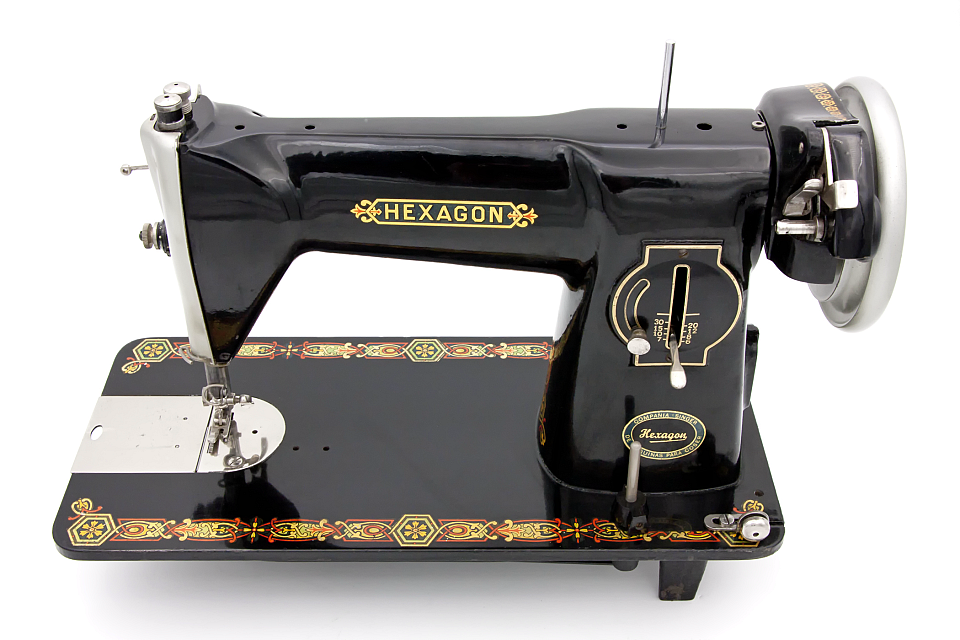
Figure 18:
The ‘Hexagon B’ (serial B 121797), manufactured by Rápida in 1959
In the last days of 1958, the first units of the new Hexagon B (Figure 18), a machine almost identical—except for its decals and the front cover—to those manufactured by Singer as models ’15-75’, ‘15B’ or ‘15M’, left the Barcelona factory. From the ‘B’ model launch, the previous Hexagon was immediately discontinued and, although it had never had a specific name, was retroactively renamed the Hexagon A, just to differentiate it from the new one.
To allow machinery of any type to be manufactured under license, the Spanish administration at the time required that, at most, 20% of the value of its components could be imported during the first year of production, and reducing that amount to 10% from the second year onwards.15 Anticipating that the complete machine would need, in addition to the machine itself, other elements manufactured in Spain (treadles, cabinets, transport cases, motors, accessories, etc.), an unknown but significant percentage—for sure, greater than 20%—of the machine’s head ended up being imported. Thus, a notable segment of these components was shipped from the Italian factory in Monza and, to a lesser extent, also from Bonnières. Conversely, an unknown number of components manufactured in Barcelona ended up being sent to those other two factories.11
The numbering of model ‘A’ was continued in model ‘B’, but this time with the letter “B” preceding the serial number (e.g.: B 128705). A relatively small quantity—about 32,000 units—of this model, soon replaced by the ‘800z’ model, were manufactured.
By the beginning of 1960, once Singer had signed the master agreement with the Spanish manufacturers, the ‘800z’ model (the first of the 800 series) began to be produced by Rápida in Barcelona.8 It was exactly like the previous ‘Hexagon B’, but this time with Singer branding, and painted in the brown/beige/cream colour palette so typical during that decade (Figure 19).
Around 160,000 units of the ‘800z’ model (numbered Z******, starting with Z 200,001) were manufactured between 1960 and 1970, by far, the most successful 800 series model.
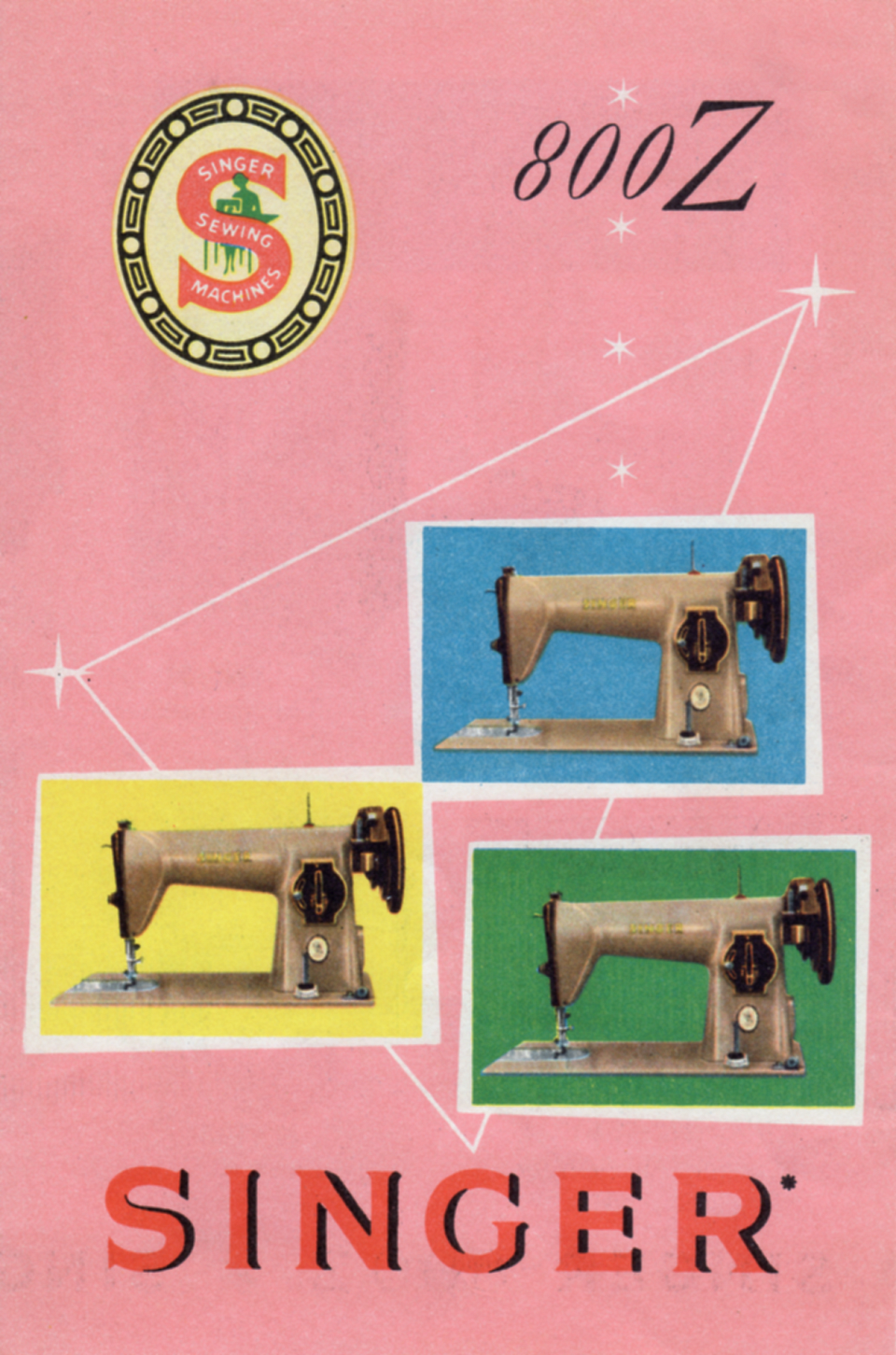
Figure 19:
Brochure of the Singer ‘800z’ model, manufactured by Rápida since 1960
Epilogue
The last of the Hexagon sewing machines, obviously a ‘Hexagon B’, left the Rápida and Hispano Olivetti joint factory in Barcelona in February 1960.
Is that the end of story? No! There’s still a little coda left.
Some of the 800 series machines were marketed with a certain electric motor made in Spain. Do you know what brand those motors were?
We are sure you’ve already guessed it: Hexagon, of course!
That is to say, the association of Singer with the Hexagon brand did not end in the 1920s, as had traditionally been assumed, nor in 1960, when the last ‘Hexagon B’ was produced. The Hexagon brand continued to be associated with Singer, yes, marginally, in the form of a small electric motor, until, as late as 1990, when the last of the 800 series machines equipped with a Hexagon motor left the EyESA (Sigma) factory, in the Spanish Basque Country (Figure 20).
Singer was then facing its final downfall.
Rápida, for its part, had stopped manufacturing sewing machines long before that, in 1970.1 And that, yes, is the final point in the Hexagon sewing machine’s history.
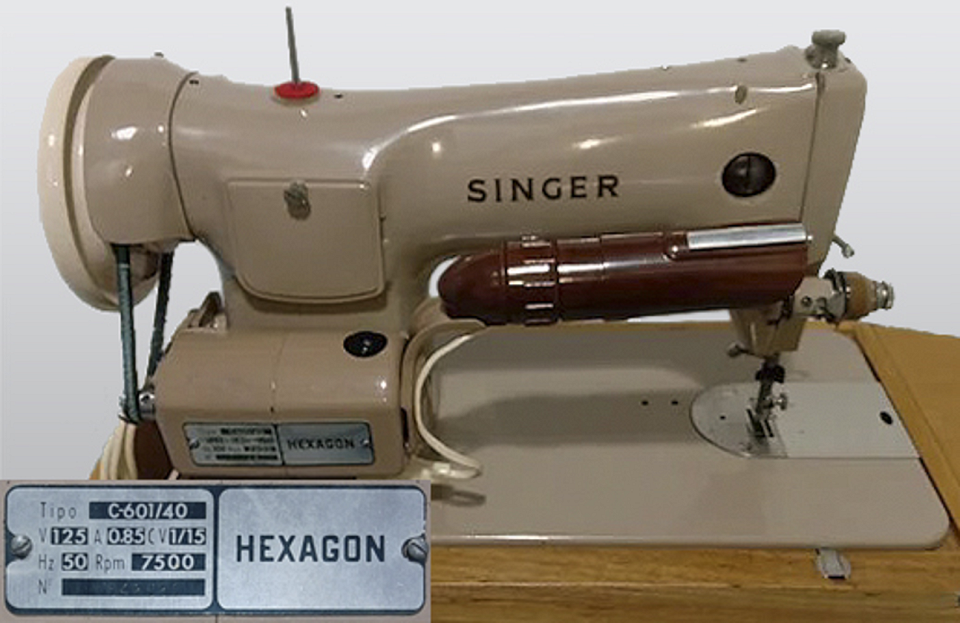
Figure 20:
A Singer ‘827z’ manufactured by EyESA (Sigma) in the late 1960s, with a Hexagon electric motor
Summary
The table below summarises the main data related to the six different models of Hexagon sewing machines, as explained throughout our two-part article.
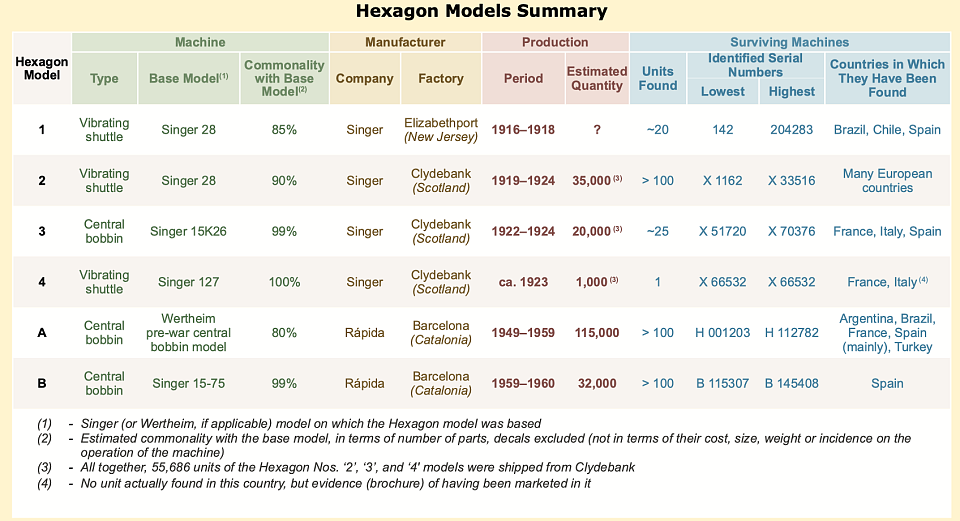
Table 1:
Summary of Hexagon Models
References
- Hispano Olivetti S.A. Document archive ANC1-422-T. Arxiu Nacional de Catalunya.
- Joaquim Maria de Nadal i Ferrer. Document archive ANC1-783. Arxiu Nacional de Catalunya.
- Rápida S.A. Document archive FDAMB-825. Arxiu Municipal de Barcelona.
- Singer Manufacturing Company Records. U.S. Mss AI, Micro 703 (2002, 2013, 2014, 2019, 2020). Wisconsin Historical Society, Division of Library, Archives, and Museum Collections, Madison, WI.
- La Vanguardia. Hemeroteca. Retrieved from https://www.lavanguardia.com/hemeroteca
- Aguado, A., & Ramos, M. (2002). La modernización de España (1917–1939). Madrid: Síntesis.
- Bayó i Soler, C. (2008). “Miquel Escuder i les Màquines de Cosir.” Terme, 23.
- Cebrián Villar, M. (2005). “Competitividad y exportaciones: el sector de la maquinaria téxtil en España, 1959–1975 (La Rápida y Matesa).” VIII Congreso de la Asociación Española de Historia Económica, Santiago de Compostela.
- Davies, R. B. (1976). Peacefully Working to Conquer the World: Singer Sewing Machines in Foreign Markets, 1854–1920. New York: Arno Press.
- de la Cruz-Fernández, P. A. (2013). Atlantic Threads: Singer in Spain and Mexico, 1860–1940. Florida International University, Electronic Theses and Dissertations. Retrieved from https://digitalcommons.fiu.edu/etd/953
- Fernández Steinko, A. (1997). Continuidad y ruptura en la modernización industrial de España: el sector de la maquinaria mecánica. Madrid: Consejo Económico y Social.
- Godley, A. (2006). “Selling the Sewing Machine Around the World: Singer’s International Marketing Strategies, 1850–1920.” Enterprise & Society, 7(2).
- Guilliard, C. (2018). Das Verschollene Erbe der Wertheims. Köln: Bastei Lübbe.
- Iza-Goñola, F. (2005). Alfa S.A.: Motor social y económico de la vida eibarresa. Eibar: Ayuntamiento de Eibar.
- Myro, R. (1999). “La industria española ante la competencia global.” Economía Industrial, 329, 11–19.
- P.O.U.M. (1936, November 4). “La Fábrica de Máquinas de Coser Wertheim.” La Revolución Española, (9).
- Tortella, T. (2000). A Guide to Sources of Information on Foreign Investment in Spain: 1780–1914. Amsterdam: International Institute of Social History.
- Urdangarín, C. (2009). Estarta y Ecenarro, “SIGMA”: 80 años de historia, 1914/1995. Elgóibar: Ayuntamiento de Elgóibar.
All machines and documents in uncredited photos are from the collections of the authors.
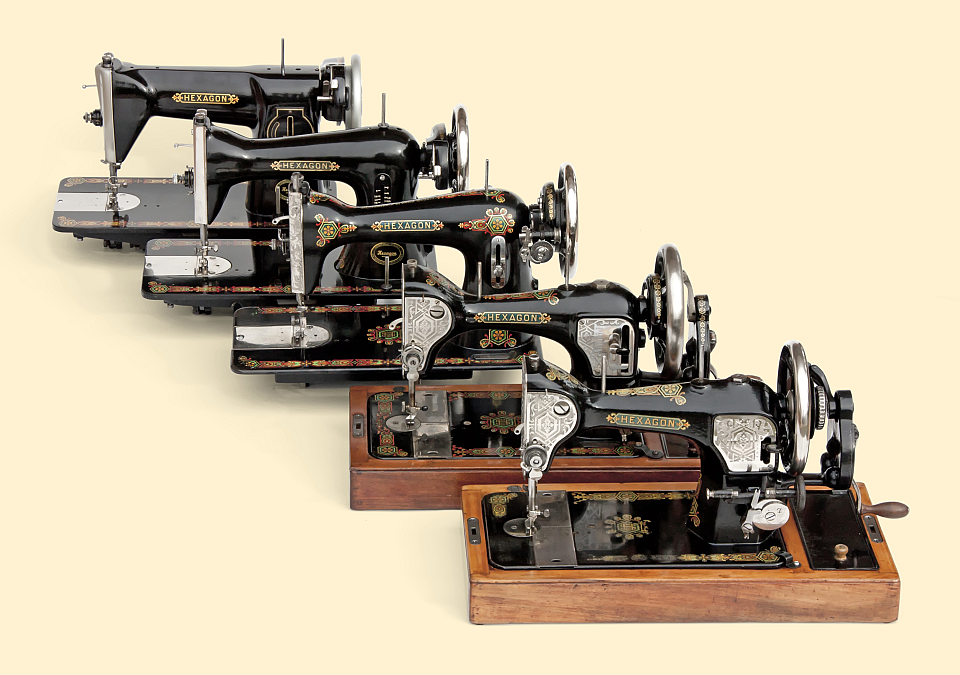
Figure 21:
The Hexagon Family, almost complete. From front to back, 'No. 1', 'No. 2', 'No. 3', 'A', and 'B' models. Only 'No. 4' is missing.